 Classic Carpet Cleaning
Professional Pet Urine & Odor Treatment
We locate the contamination with a UV light, treat the source with an enzyme-based product rather than masking it, and tell you honestly what depth of contamination means for your results.
The odor is rarely still on the surface
By the time you can smell it, the urine is almost never sitting on top of the carpet anymore. A single accident soaks through the face fiber in seconds, spreads sideways through the backing, and keeps travelling down into the cushion. What you see as a small spot on the surface is usually a much wider area underneath — often several times the size.
As it dries, the urine leaves behind salts and crystallized residue in the padding. Those crystals are not especially smelly when they are dry, which is why the problem seems to fade for a while. Add humidity, a warm afternoon, or a wet cleaning that does not address them, and they re-activate and the smell returns as strong as before. That is the whole reason a general carpet cleaning sometimes seems to make pet odor worse rather than better.
In heavier or repeated cases the contamination does not stop at the padding. It can reach the tack strip, the sub-floor, and in some cases wick into a concrete slab or soak into wood. That is a different problem from a dirty carpet, and it needs to be talked about honestly rather than papered over with fragrance.
- Face fiber — the part you can see and the least of the problem
- Backing — where the contamination spreads sideways
- Padding — where crystallized residue collects and reactivates
- Sub-floor — in repeated or severe cases, the actual source of a smell that will not leave

Our Pet Urine & Odor Process
Find it first, treat the source, then tell you the truth about what to expect.
UV black-light inspection
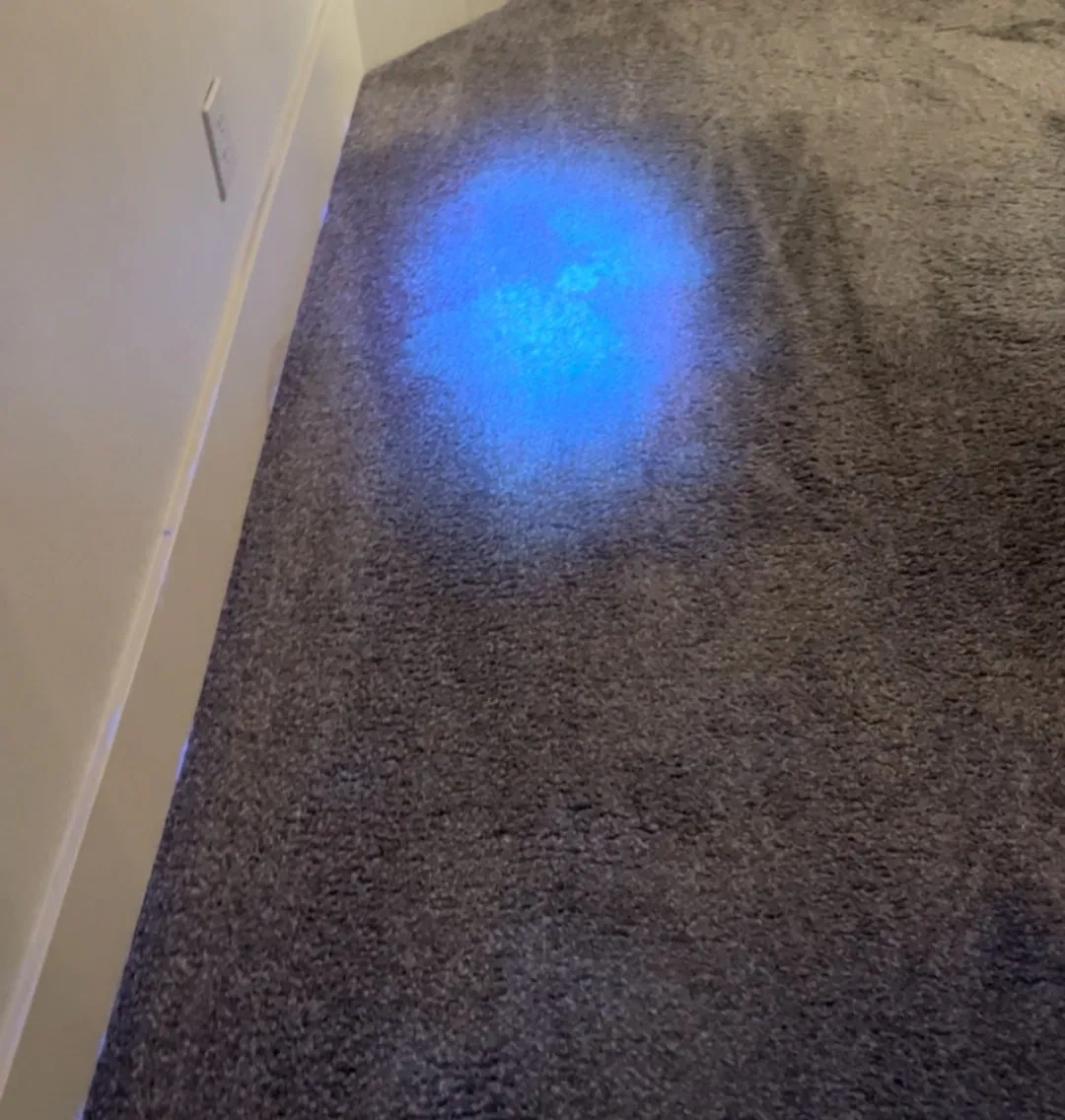
We darken the room and inspect with a UV black light. Urine residue fluoresces, which shows us the real edges of each affected area rather than just the visible stain — including spots you never knew about.
Assessment and honest conversation
We map how many areas are involved and how far the contamination appears to have travelled, then tell you before we start what we expect to be able to achieve. If we think a room needs more than a topical treatment, we say so.
Enzyme-based treatment
We apply an enzyme-based odor neutralizer directly to the affected areas and give it dwell time to work on the residue causing the smell. This is treatment at the source, not a fragrance laid over the top.
Hot water extraction
The treated areas are flushed and extracted with our truck-mounted equipment, pulling the broken-down residue and contamination up and out of the carpet rather than driving it deeper.
Re-check and follow-up plan
We re-inspect the treated areas and talk through drying. If we believe additional treatment or a follow-up visit may be needed once everything is fully dry, you will hear that from us on the day.
A deodorizer is not a treatment
Anything you can buy in a spray bottle to make a room smell better is working on your nose, not on the carpet. Fragrance covers the odor for a few days, then wears off and leaves the underlying residue exactly where it was. Powders and dry deodorizers do much the same thing, and some of them add a second problem by settling into the pile.
An enzyme-based treatment works differently — it goes after the residue that is producing the odor rather than sitting on top of it. But it can only work where it can actually reach. That is the single most important thing to understand about pet odor: results depend far more on how deeply the contamination has penetrated than on which product gets used. A fresh accident caught on the face fiber and backing responds very well. Years of repeat accidents in the same corner, soaked through the pad and into the sub-floor, is a much harder situation and sometimes cannot be fully resolved by cleaning alone.
We do not promise complete odor removal in every situation. We will tell you at the inspection what we think is realistic for your carpet, and if we believe the honest answer is that the padding needs replacing or the sub-floor needs sealing, we will tell you that instead of taking your money for a treatment that will not hold.
What contamination depth means for your results
Same product, same technician, very different outcomes — because the variable that matters most is how far it went.
Surface and backing only
Recent accidents, promptly blotted, that have not soaked through into the cushion. These respond well and odor is usually resolved with a single treatment.
Into the padding
Larger or older accidents where residue has collected in the cushion. Treatment usually produces a substantial improvement, but a follow-up may be needed and some residual odor can remain in humid conditions.
Through to the sub-floor
Repeated accidents in the same area over a long period. Topical treatment can reduce the odor but often cannot eliminate it, because the source is beneath the carpet. This may require pad replacement or sub-floor sealing, which is work beyond a cleaning visit.
We will tell you which of these three we think you are dealing with before we start — not after.
What pet treatment costs
Pet urine and odor treatment is $45 per room as an add-on, and there is no room minimum on it. It is also included free in our Classic Premier Total Care package at $389, which covers 3 rooms or areas up to 600 sq ft and carries a 30-day guarantee with a free re-clean of missed spots.
If pet odor is the main reason you are calling, Premier Total Care is usually the sensible route — it bundles the treatment with the CRB deep agitation and protector application, and it gives you the longest guarantee window to come back to us if something resurfaces as it dries.
Why the two go together
Pet treatment is not a substitute for cleaning the carpet, and cleaning the carpet is not a substitute for pet treatment. They solve different problems. Extraction removes soil; the enzyme treatment addresses odor residue in the affected areas.
Booked together, the treatment is applied to the identified areas with dwell time and then flushed out during the extraction pass, which is the sequence that gives it the best chance of working. Booking odor treatment on its own, without extraction, generally leaves the broken-down residue in the carpet — which is why we do it as part of a cleaning rather than in isolation.
Where we treat pet odor
Frequently Asked Questions
In many cases we substantially reduce or resolve it — but we won’t promise complete removal in every situation, because that isn’t honest. The deciding factor is depth. Contamination limited to the fiber and backing responds well. Urine that has soaked through the pad and into the sub-floor may not be fully resolvable by cleaning alone, and we’ll tell you that at the inspection.
As urine dries it leaves salts and crystallized residue in the backing and padding. Dry, those are relatively odorless — which is why the problem seems to fade. Add humidity or the moisture from a general cleaning that didn’t specifically treat the affected areas, and they reactivate and the smell comes straight back.
We darken the room and go over it with a UV black light. Urine residue fluoresces, which shows us the real edges of each affected area rather than just the part you can see — and it regularly finds spots homeowners had no idea were there.
Yes, and it usually does. A single accident can pass through the face fiber and backing into the cushion within seconds. Repeated accidents in the same spot can reach the tack strip and the sub-floor beneath. When the source is underneath the carpet, a topical treatment can reduce the odor but may not eliminate it — sometimes the honest answer is pad replacement or sub-floor sealing.
They’re two separate problems. Our treatment targets the odor at its source. The visible mark often lightens considerably or goes entirely — but urine can permanently alter carpet dye, and where that has happened the discolouration stays even after the odor is dealt with.
Completely. A deodorizer or fragrance covers the smell for a few days and then wears off, leaving the residue exactly where it was. An enzyme-based treatment works on the residue producing the odor rather than sitting on top of it — which is why we apply it to the identified areas with dwell time and then extract it.
We do pet treatment as part of a carpet cleaning rather than on its own. The treatment needs dwell time and then needs flushing out with extraction, so the two belong together — extraction handles the soil, the enzyme treatment handles the odor residue. See how our carpet cleaning works.
It’s $45 per room as an add-on, with no room minimum — and it’s included free in Classic Premier Total Care at $389 for 3 rooms or areas up to 600 sq ft, which also carries our longest guarantee window.
Talk to us about the pet odor
Tell us how long it has been going on and roughly how many spots there are, and we will tell you honestly what we think we can do about it.